
All examples
Devtools overlay
- Mouse
- Keyboard
- Touch
- Gamepad
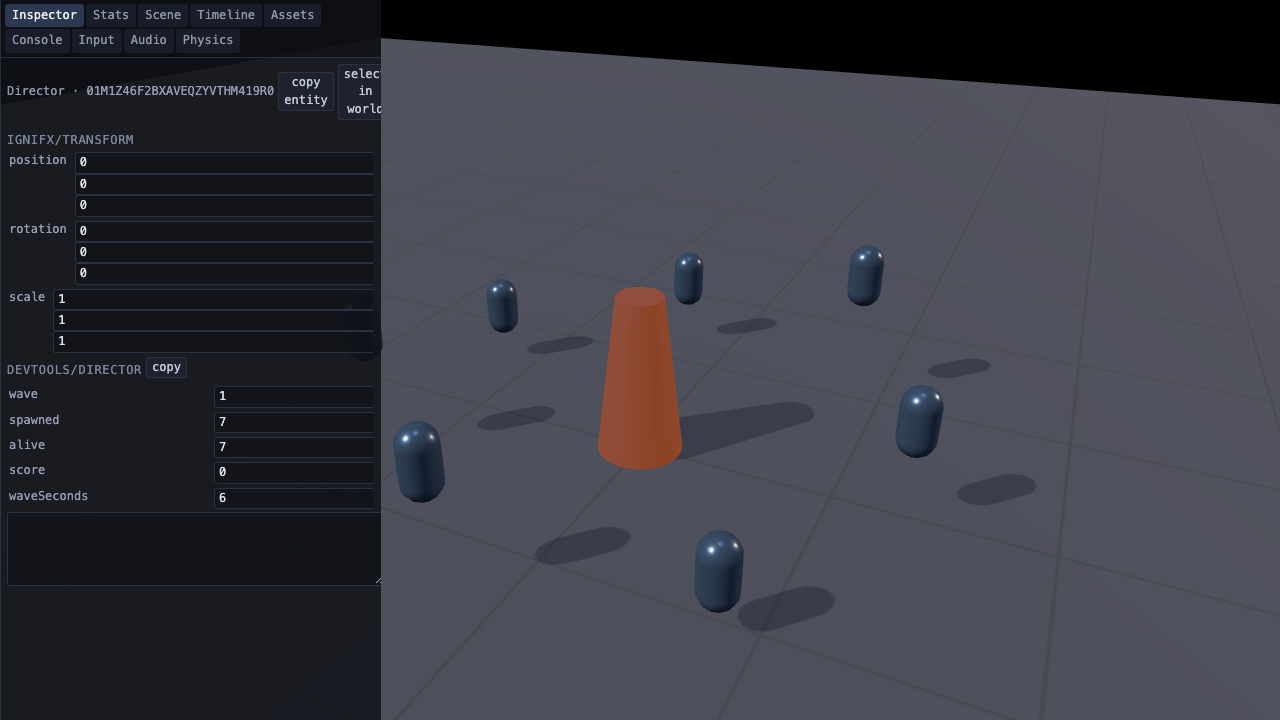
The developer tools open with this example. Explore the scene tree, edit the Director’s fields and watch the wave timing change. Use the other tabs to inspect performance, assets, input, audio and physics.
WebGPU: checking…See browser support
Try this
- Type a new number into the Inspector's `waveSeconds` row and watch the wave clock follow it.
- Open Stats for draw calls and engine CPU, then Timeline for the same frame, phase by phase.
- Select a drone in the Scene tab: the Inspector follows, down to its live transform.
Show source code
Source
import { Camera } from "ignifx";import { bootExample } from "../_kit/boot.ts";import { attachOrbit } from "../_kit/orbit.ts";import { bind, button, readout, slider, toggle } from "../_kit/panel.ts";import { createGridGround, createLightRig } from "../_kit/stage.ts";import { Director } from "./director.ts";import { createRing, Drone, START_SPEED } from "./ring.ts";import type { DevtoolsPanelName } from "ignifx";/** * The devtools overlay, open before you arrive. * * `@ignifx/devtools` is one extension and one key. Register it, press backtick, and nine tabs * appear over the canvas: frame numbers, the entity tree, a live component inspector, asset * handles, input, audio, physics, the log and a per-phase timing graph. It costs nothing while it * is closed — no system runs, no signal is subscribed to and no DOM exists until `open()` — which * is why a game registers it behind a development flag and then forgets about it. Every other * example on this site carries it too; press backtick on any of them. * * This is the one page that opens it for you, through the `devtools` settings section below. * `openOnStart` does it, `position: "left"` keeps it clear of the parameter panel, and `panels` * both re-orders and filters the tab strip — so the overlay opens on the **Inspector**, pointed at * the `Director` entity. * * The Inspector is where a game's own state shows up. Every `Script.define` field is a row it reads * and writes: type a number into `wave` and the next frame's `update` uses it, because the rows * write through to the live component. `director.ts` also publishes the same four numbers into * `app.diagnostics`, which is the API the Stats panel's own rows come from and the one a headless * test reads without opening anything. * * Worth knowing before copying that last part: the Stats panel draws a **fixed** list of engine * counters. A custom group is read back with `app.diagnostics.group("game")` — as the panel on the * right does — and is not a row on the overlay. *//** The nine panels, in the tab order this example wants: the Inspector first, then the rest. */const PANELS: readonly DevtoolsPanelName[] = [ "inspector", "stats", "scene", "timeline", "assets", "console", "input", "audio", "physics",];/** How many of {@link PANELS} get a "Show" button in the parameter panel. */const SHORTCUTS = 4;bootExample({ title: "Devtools overlay", settings: { rendering: { clearColor: { r: 0.043, g: 0.059, b: 0.094, a: 1 }, msaaSamples: 4, features: { shadows: true }, }, devtools: { openOnStart: true, position: "left", panels: [...PANELS], opacity: 0.94 }, time: { fixedDeltaTime: 1 / 60 }, }, async setup({ app, panel }) { app.registerComponents([Director, Drone]); const focus = { x: 0, y: 0.5, z: 0 }; const eye = app.world.createEntity("Main Camera"); eye.addComponent(Camera, { near: 0.1, far: 200, fov: 44 }); attachOrbit(app, eye, { yaw: 26, pitch: 27, distance: 4.4, target: focus, minDistance: 2, maxDistance: 14 }); const rig = createLightRig(app, { focus, shadows: true, shadowDarkness: 0.3 }); await createGridGround(app, { size: 24 }); createRing(app); // The entity the overlay opens pointed at. `select` works before `app.start()` — the service // exists from `createApp` — so the Inspector has something to show on its first refresh. const stage = app.world.createEntity("Director"); const director = stage.addComponent(Director); app.devtools.select(stage); panel({ title: "Devtools overlay", groups: [ { label: "Overlay", controls: [ toggle("Open", { value: true, change: (on: boolean): void => { // `open()` builds the DOM and registers the sampler; `close()` disposes the DOM. // The sampler stays registered afterwards and returns on its first line, because // core's scheduler has `registerSystem` and no `unregisterSystem`. if (on) { app.devtools.open(); } else { app.devtools.close(); } }, }), ...PANELS.slice(0, SHORTCUTS).map((name: DevtoolsPanelName) => button(`Show ${name}`, (): void => { app.devtools.panel(name).show(); }), ), ], }, { label: "Gameplay", controls: [ slider("Wave length", { min: 1, max: 12, step: 0.5 }, bind(director, "waveSeconds")), slider( "Drone speed", { min: 0, max: 120, step: 4 }, { value: START_SPEED, change: (speed: number): void => { for (const drone of app.world.components(Drone)) { drone.speed = speed; } }, }, ), toggle("Key light casts", bind(rig.key.shadows, "enabled")), button("Next wave", (): void => { director.advanceWave(); }), ], }, { label: "app.diagnostics", collapsed: true, controls: [ readout("game/wave", (): string => director.read("wave")), readout("game/spawned", (): string => director.read("spawned")), readout("game/alive", (): string => director.read("alive")), readout("game/score", (): string => director.read("score")), readout("Scripts updated", (): string => String(app.diagnostics.frame.scriptsUpdated)), ], }, ], }); },});/** * The gameplay the overlay watches: a wave counter with four serialized fields, published once a * frame into a counter group on `app.diagnostics`. * * @remarks * It is the shape `skills/ignifx/references/recipes/show-diagnostics-in-devtools.md` recommends, * and the reason it is that shape is the per-frame path. A counter group is a **fixed list of names * over a numeric array**: register it once, resolve each name to an index once in `awake`, then * `set` by index in `update`. No string is hashed and nothing is allocated after the first frame. * * `groupOrRegister` rather than `registerGroup`, because a second registration of the same name is * `IGX-1503` and a scene reload runs `awake` again. * * The fields are declared with `Script.define`, which is what puts them in the devtools Inspector * as editable rows: `wave` typed into the overlay is `wave` in the next frame's `update`. That is * the whole reason this class has fields rather than private state. */import { f32, i32, Script } from "ignifx";import type { DiagnosticsGroup, ScriptCallbacks } from "ignifx";/** The counter group's name, as `app.diagnostics.group("game")` asks for it. */export const COUNTER_GROUP = "game";/** The counters, in the order their indices are resolved. */export const COUNTER_NAMES = ["wave", "spawned", "alive", "score"] as const;/** One of {@link COUNTER_NAMES}. */export type CounterName = (typeof COUNTER_NAMES)[number];/** How many drones a wave is worth, so the numbers on screen mean something. */const SPAWNS_PER_WAVE = 7;/** * A wave director: four numbers a game would have anyway, on the clock and in the diagnostics * table. * * @example * ```ts * const stage = app.world.createEntity("Director"); * const director = stage.addComponent(Director); * app.devtools.select(stage); * ``` */export class Director extends Script.define({ wave: i32(1, { min: 1, tooltip: "Which wave is running." }), spawned: i32(0, { min: 0, tooltip: "How many drones have been spawned in total." }), alive: i32(SPAWNS_PER_WAVE, { min: 0, tooltip: "How many are still flying." }), score: i32(0, { min: 0, tooltip: "Points banked." }), waveSeconds: f32(6, { min: 0.5, tooltip: "How long one wave lasts, in seconds." }), }) implements ScriptCallbacks{ /** The namespaced registration id. */ static typeId = "devtools/Director"; /** The counter group, resolved once. */ #group: DiagnosticsGroup | null = null; /** The counters' indices, in {@link COUNTER_NAMES} order. */ readonly #indices: number[] = []; /** Seconds left in the current wave. */ #remaining = 0; /** Registers the counter group and resolves its indices — once, not per frame. */ awake(): void { const group = this.app.diagnostics.groupOrRegister(COUNTER_GROUP, [...COUNTER_NAMES]); this.#group = group; this.#indices.length = 0; for (const name of COUNTER_NAMES) { this.#indices.push(group.index(name)); } this.#remaining = this.waveSeconds; this.spawned = SPAWNS_PER_WAVE; } /** * Runs the wave clock and writes the four counters. * * @param dt - Seconds since the previous frame, scaled by `time.timeScale`. Under `?static=1` * the scale is zero, so the wave holds where it was authored and the overlay's own refresh — * which runs on the unscaled clock — keeps drawing it. */ update(dt: number): void { this.#remaining -= dt; if (this.#remaining <= 0) { this.advanceWave(); } else if (this.alive > 0 && dt > 0) { // A wave thins out across its length rather than in one step, so the numbers on the overlay // move while you watch them. const share = Math.floor((1 - this.#remaining / Math.max(this.waveSeconds, 0.5)) * SPAWNS_PER_WAVE); const cleared = Math.max(0, Math.min(SPAWNS_PER_WAVE, share)); const left = SPAWNS_PER_WAVE - cleared; this.score += Math.max(0, this.alive - left) * 10; this.alive = left; } const group = this.#group; if (group === null) { return; } group.set(this.#indices[0] ?? 0, this.wave); group.set(this.#indices[1] ?? 0, this.spawned); group.set(this.#indices[2] ?? 0, this.alive); group.set(this.#indices[3] ?? 0, this.score); } /** Starts the next wave: what the panel's button and the wave clock both call. */ advanceWave(): void { this.wave += 1; this.alive = SPAWNS_PER_WAVE; this.spawned += SPAWNS_PER_WAVE; this.score += 100; this.#remaining = this.waveSeconds; } /** * Reads one counter back out of the diagnostics table. * * @remarks * Through the group rather than off the field, on purpose: it is the same read a HUD, a test or * the Stats panel would do, and it proves the number reached the table. * * @param name - Which counter. * @returns The value, or `"—"` before `awake` has run. */ read(name: CounterName): string { const group = this.#group; if (group === null) { return "—"; } return String(group.get(group.index(name))); }}/** * The scene the overlay watches: a pylon and a ring of drones that keep moving, so the Stats * panel's numbers change and the Timeline graph has something to draw. * * @remarks * A separate file for the reason `pbr-model/shot.ts` is: none of it is a lesson about devtools. * `main.ts` is then the settings section that opens the overlay, the selection it opens pointed at, * and the panel that drives both. * * The loop at the bottom is exactly what the overlay's **Scene** tab shows: one entity per drone, * named, under the world's root. Selecting a row there points the Inspector at that drone, and the * Inspector's rows are this file's `Script.define` fields. */import { createMaterialAsset, f32, i32, MeshAsset, MeshRenderer, pbrMaterialDefinition, Script } from "ignifx";import type { App, ScriptCallbacks } from "ignifx";/** How many drones orbit the pylon. */export const DRONES = 7;/** The speed a drone starts at, in degrees per second, before its per-index stagger. */export const START_SPEED = 36;/** Carries one drone around the centre. */export class Drone extends Script.define({ index: i32(0, { min: 0, tooltip: "Which drone this is; sets its phase around the ring." }), speed: f32(START_SPEED, { min: 0, tooltip: "Degrees around the ring per second." }), radius: f32(1.35, { min: 0.1, tooltip: "How far out the drone flies, in metres." }), }) implements ScriptCallbacks{ /** The namespaced registration id. */ static typeId = "devtools/Drone"; /** How far round the circle this drone has travelled, in degrees. */ #angle = 0; /** * Advances the orbit. * * @param dt - Seconds since the previous frame, scaled — so `?static=1` holds the ring still * while the overlay keeps refreshing, because the overlay runs on the **unscaled** clock. That * is what makes this example's capture reproducible with the overlay up. */ update(dt: number): void { this.#angle += this.speed * dt; const phase = ((this.index / DRONES) * 360 + this.#angle) * (Math.PI / 180); this.transform.localPosition.set( Math.cos(phase) * this.radius, 0.5 + Math.sin(phase * 2) * 0.22, Math.sin(phase) * this.radius, ); }}/** * Builds the pylon and the ring. * * @remarks * `app.registerComponents([Drone])` is the caller's job, because a game registers every component * it uses in one place. * * @param app - The app the entities and the assets belong to. * * @example * ```ts * app.registerComponents([Drone]); * createRing(app); * ``` */export function createRing(app: App): void { const shell = createMaterialAsset( app, pbrMaterialDefinition({ name: "devtools/shell", baseColor: { r: 0.3, g: 0.42, b: 0.55, a: 1 }, metallic: 0.5, roughness: 0.32, }), [], ); const core = createMaterialAsset( app, pbrMaterialDefinition({ name: "devtools/core", baseColor: { r: 0.18, g: 0.2, b: 0.24, a: 1 }, metallic: 0.2, roughness: 0.55, emissive: { r: 0.55, g: 0.24, b: 0.06, a: 1 }, }), [], ); const pylon = app.world.createEntity("Pylon"); pylon.transform.localPosition.set(0, 0.42, 0); pylon.addComponent(MeshRenderer, { mesh: MeshAsset.cylinder(app, { height: 0.84, diameterTop: 0.24, diameterBottom: 0.44, tessellation: 24 }), materials: [core], castShadows: true, }); // One mesh shared by every drone, one entity each. const droneMesh = MeshAsset.capsule(app, { height: 0.34, radius: 0.09, tessellation: 12 }); for (let index = 0; index < DRONES; index += 1) { const drone = app.world.createEntity(`Drone ${String(index + 1)}`); drone.addComponent(MeshRenderer, { mesh: droneMesh, materials: [shell], castShadows: true }); drone.addComponent(Drone, { index, speed: START_SPEED + index * 3 }); }}